Friday, July 14, 2006

Searching for Succulents in Patzcuaro Michoacan Mexico

I have been in Patzcuaro for three days now. I am staying at a wonderful little hotel, called Posada de al Salud. It has that name because it's right across a plaza from the Basilica de la Salud. A very old and beautiful Cathedral where once a month the sick and infirm come from special prayers and healing.
The patios here are filled with lots of more tropical plants, including a hibiscus and bouganvilleas. But my search here is for succulent plants. The 10 year old taxi driver (he wasn't really ten but he was small and very young looking) told me where some nurseries are in town, and said he knew because his mother is a teacher and loves to garden.

I don't think I would be comfortable living and gardening in the coastal mountains of Mexico. It's too cold and too high (5,000-7,000 feet) around Morelia and Patzcuaro, and I like the tropical plants much better than the plants here. Although they seem to be able to grow alot of tender plants within the protected climate of the patios that are part of each house (and most hotels and restaurants and stores). Succulents too.

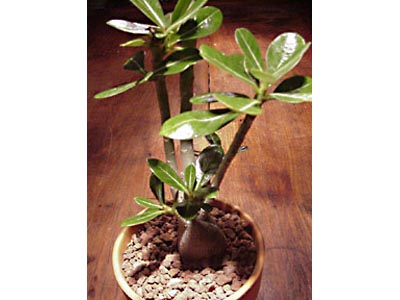
I haven't seem to be able to get it together to look for nurseries around Patzcuaro. Everytime I started thinking about finding a taxi and heading out it started raining. So I ended up window shopping, and somehow ended up in a patio surrounded by gift-y shops. The patio was full of orchids and a few succulents. The owner, Felipe, showed me almost all his plants. One of the two succulents was a lovely plant with wide flat leaves and a beautiful pink blossom growing out of the center. Felipe said the fuzzy furry looking blossom would grow to about six or eight inches. He wanted alot of money for it. Instead I took the other succulent, which I am going to find the name for on the Web.
Orchid in a tree or orchid tree in Patzcuaro
(courtesy of Ann C.)
(Later) During my last afternoon in Patzcuaro I returned to the tiny orchid nursery off the grand plaza, to pass on a lovely Spanish gardening magazine, to Felipe, the owner. And guess, what? He had a some succulent starts for me, that he had gotten from home. He said he was going to bring them up to the hotele after he closed up. Pretty neat.

Then I went back to the internet place to wait out another rainstorm. When I asked if they had a restroom, the young man sent me upstairs to a kind of open area where there were a whole bunch of different succulent plants growing. I went back downstairs, and asked the young man whose plants they were. I said I wished I could take a couple of little pieces of some of the plants. He went upstairs with me, and helped me take a few pieces. I don't know who the plants actually belong to.

I managed to bring home 10 succulent starts and one large plant. On the bus. Overnight.
Everything looks good so far, but it's too soon to tell, really. At least I was forced to let the starts heal over a little. Usually I am so anxious to get the cuttings in the ground I don't wait long enough, and they rot.

Monday, July 10, 2006

Gardens in Morelia, Michoacan, Mexico

The tree the pinata is hanging from is in the Chacala churchyard.
The tree in the picture provides shade for all the church events, for fisherman knitting nets, and for kids playing, and men visiting and talking. The large church bell hangs from the tree, announcing when the priest has arrived in town to offer a Mass, a Novena, a Baptism, wedding, funeral, Confirmation, or a special Saint's day celebration. Everyone seems to have a different name for the tree. It is huge, and takes many children's arms to encircle it. It's hard to see from the photo just how big it is.

I am taking a week trip to Morelia and Patzcuaro, in the state of Michoacan. The climate is really different than in Chacala, even though we are quite a ways south of where I live. Both of these towns are high in the mountains, I think around 5,000 feet for Morelia and 7,200 feet for Patzcuarto. The cool weather, with sunny days and some early evening rain, are really a nice change from hot, humid Chacala.

There doesn´t seem to be any special public gardens around here, but I have been to a couple of plant nurseries, just to see what they grow here. There are many plazas in Morelia with plants and trees, but nothing has really caught my eye. It sure is not tropical here.

Yesterday, as I took the bus from the bus station closest to Chacala, which is in Las Varas, up thru the mountains and farmlands (mainly agave plants) thru to Guadalajara, and then further south to Morelia. Over the day's travel there was a big change in the tree situation.
First, palms, and some gorgeous decidious trees around home, then a number of trees if don't know the names of, or if I do I don't know how to spell them. There were still a few palms heading up to Tepic, then no trees at all, just agave farms. The spikey, blue agave plants, marching across the landscape in straight rows are really eye-catching, and beautiful. Very, few trees during that three hour drive. And then, when we left Guadalajara, there were no trees, just tall shrubs, until the last half hour before Morelia, when there were fir trees. I am just starting to get the names of the trees around the outskirts of town.

I know one thing, and that´s that even though I love the buildings in Morelia, I don´t especially enjoy the urban environment. I´m not sure I could live in a big city again. There are 500,000 people here. It doesn't seem that big. I guess there are some taller buildings somewhere in this town, but I haven't seen them yet. Except for the cathredal and some of the churches.

I am really missing the bouganvilleas and hibiscus and palms, and all the beautiful plants and birds and butterflys at home in Chacala. And it's only been a couple of days.

Sunday, July 02, 2006

Water For My Plants in Chacala

I had town water coming to the pipe at the house today for about three hours . The pipe was really full of water, and it just kept coming. I felt rich!

After I topped off both of my water storage tanks (tinachos) I had a great times watering everything. Everything, even baby palms growing on their own out to the south of the house. And some shrubs on the east side, near the driveway.

But mostly I watered the big pots on both the sunny and shady terraces until I was sure they were watered all the way down. And I watered the little garden downstairs, outside the water storage area. I even hosed off the stairs and both patios and hosed off the outside walls, home to millions of insects and spiders. Sorry, guys.

Photo thanks to Scott Parks at http://www.sparks_mexico.com
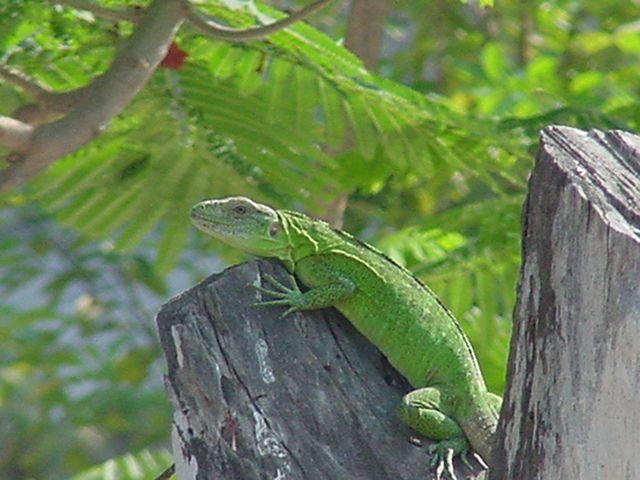
A little guy just like this iguana lives on my front patio, hiding in the plants and around the pots.
I don't think he's afraid of me, because as long as I'm not watering, he just hangs around watching me.


The spring my landlady started a nice little garden next to the tiny porch near one of the water waters, but the soil is really hard and rocky there and I am not really too optimistic. I really watered them all today: four new small bouganvilleas, two crotons, two hibiscuses and another greenery-type plant I don't know the name of.

These plants are all in the full sun, for maybe ten hours a day, and I think it is just too hot for them. Except for the bouganvilleas. They seem to love the sun and heat and humidity. The hibiscus plants are looking pretty good, but no blossoms yet. They have been in the ground for about six months, so who knows.
Then I did some cuttings, hoping to grow some new baby plants. I have been having some trouble the last couple of weeks with my Desert Rose (adenium obesum?) cuttings. Usually I just hack a branch off and stick it in a pot of nice soil, but lately they have been dying. So I am being more careful about letting them callus over before I plant them, and making sure they are way out of the sun. Maybe it's make a difference. The next thing might be to try some new dirt, if I can find some.

My jasmine and hisbiscus cuttings are all looking pretty good. I started a new bunch of hisbiscus cutting today. I am trying to keep track of which plant the cfuttings came from so I can tell people what color the blossoms might be. But I am not good at keeping labels straight, so who knows. I'm hoping to have lots of plants to share soon. And to take with me when I move back to the beach or where ever I am going when my landlords come back, maybe in late November.

I am watching for the "plastico" truck to come by so I can buy a couple of shallower plastic pans for my cuttings. The "plastico" truck sells everything you can think of made of plastic, except Legos, I guess. He turns his musical horn off before he gets to this end of town, so I have to keep an eye out for him.

Saturday, July 01, 2006

Holding My Breath for Rain in Chacala

I think this is a poinciana tree, in full bloom, but it might not be.
Someone else took the photo.

Everyone in town is holding their breath, waiting for the rainy season to start. We had a tiny little rainful right around the Solstice, and one little bitty shower a few nights later, and that's it since early October.

The leaves on the mango trees outside my window are looking very droopy and thirsty. This is the third summer without much water, and the plants must be suffering.

Right now I am computing out on the patio. Ahead of me the sun is setting and the rain (I hope) clouds are reflecting red all over the sky. To the south, there are very, very dark rain clouds and there is loud thunder. No lightning yet, but I am going in the house. I have to unplug everything and pull furniture away from the windows. The windows just have screens, so if it gets windy, the rain comes in and helps me wash the floors.

I just dragged all the potted plants on the patio under the dripline from the roof, so they will get some water. I have about 25 pots out on the sunny patio, some of them mine, and some of them my landlords.

I figure I I act like it's going to rain, maybe it will. I can hear the thunder getting closer and I have to get upplugged.
This is a friend of mine standing next to a tree
I planted from seed last year.
Just kidding!
add name

Plants Delivered to Your House in Chacala

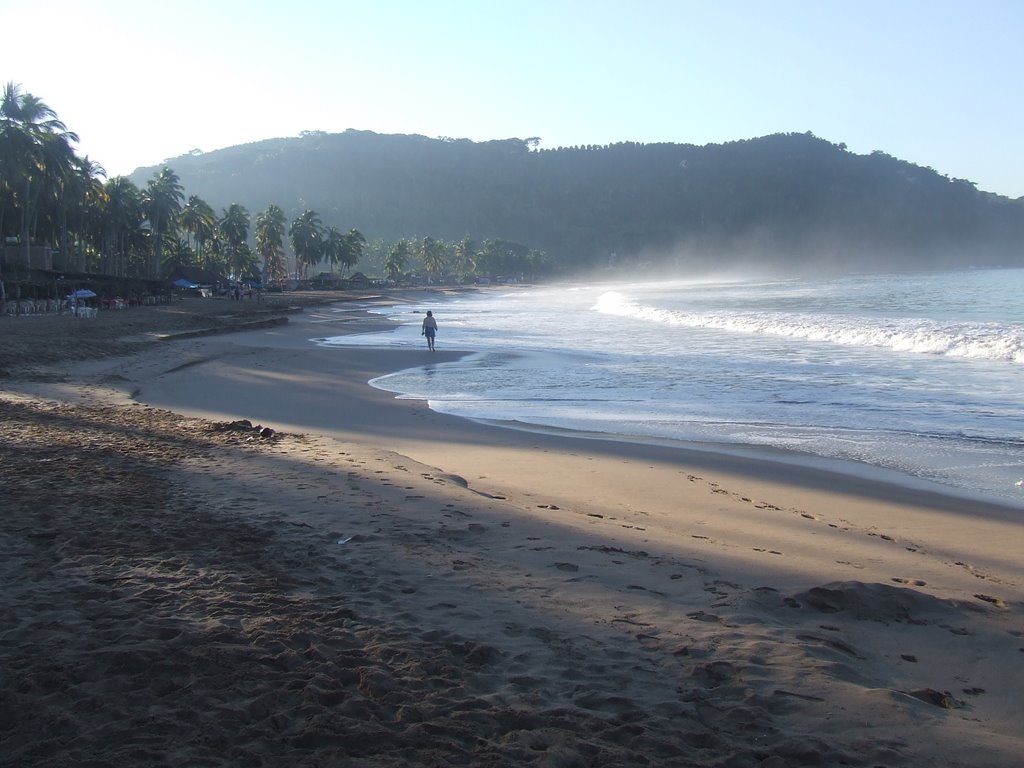
My morning walk at sunrise on Playa Chacala
Yesterday afternoon I walked down to the road from my house, to check to see if the man who takes orders for the big Coke truck had come by yet.... Anyway, this is about gardening, not Cokes.

As I walked down the driveway my neighbor lady, Maria Pelila (sort of like Granny Maria) came running up the driveway, talking rapidly and loudly. She's tiny and looks really old (no teeth), but she's only in her 50's. Anyway, it took a minute for me to understand she was saying that the vivero (nursery) truck was here. That's a truck that comes around to really small towns like Chacala selling plants. They are more expensive than the plants at the nurseries, but cheaper than if you have to take the bus and taxi to the nursery.

Anyway, I ran back up to the house for some money and to change out of the very thin tee-shirt I wear when it's this hot. Then we trotted over to the Maria's, where the nursery truck was parked under a tree. It was very hot and humid and everyone standing around the truck was dripping with sweat. Prespiration.

At first it looked like the usual selection of plants: lately it's been hydrangeas, roses, plain geraniums, vinca, and some kind of greenery plants. Like for decorating offices.

But this time she also had five succulent plants that I think of as portulaca, but I don't think that's their real name. These ones had kind of pointy ends on the little segments, and all different colors of blossoms. Very nice. 10 pesos, 90 cents each. And a big stonecrop for the same, and then two Desert Roses (adenium obesum), which I always buy when I see them.

They are a big favorite around here. They are new to most of the ladies in town, and anytime someone wants one, I offer a cutting/start or a plant. So I am always wanting more. This time she has two big ones, very big, for 30 pesos, maybe 2.70USD each. I am planning to leave one big and take cuttings off the other one. I just love that plant.

Maria and I seem to have silently, without discussion, struck a deal. If the plant truck comes down the street she runs up to the house and tells me. Otherwise I probaby wouldn't see the truck because it turns around before it gets to this end of town. It's about a block between our houses, and it's hot, and I feel as though she does me a big favor. And sometimes, when I'm not home, it's a wasted trip for her. Then, in return, I buy her a plant, of her choice, sort of.

I used to give her 20 pesos or so for helping me, but now we kind of pick out a plant for her together. But this time it got a little more expensive. The last time Maria was at my place she fell in love with this beautiful vine. It's got large coral blossoms. The same vine with yellow flowerrs is called Flora de Oro around here , but I know that's not the real name. I am going to start looking at on the photos at Garden Web and try to identify some of these plants. Anyway, Maria fell in the love with the red/coral blossoms and took a bunch of cuttings, which did not do well. So when she saw that same vine in the plant truck she was practically drooling. It's a beautiful plants, blossoms constantly, and grows like crazy.

But it was 60 pesos (maybe 5.40USD) which is more than I wanted to pay. Maria looked so disappointed, I couldn't stand it. So I went ahead and got it for her. Then all us plant-loving ladies in the neighborhood stood around under the tree for a few minutes, admiring other peoples' new plants.

The husband of the plant lady, who is also the truck driver, insisted on carrying my plants home, over my objections. When we got up to the house I realized there were two extra little plants, a mint and malva (which is what they call what we used to call geraniums).
So I walked back down to the truck with him, intending to give back the plants, assuming it was a mistake.

And the lady did the nicest thing. She said, "No, those are for you because you get all those plants for Maria". It made me feel really good and sort of embarrassed. Also, I understood her Spanish, mas or menos, and that always feels good.
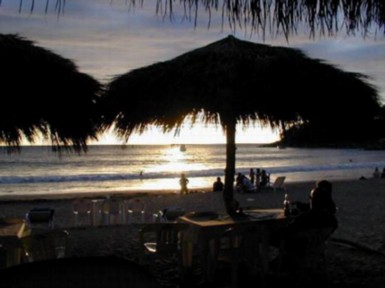
Chacala sunset

Wednesday, June 28, 2006

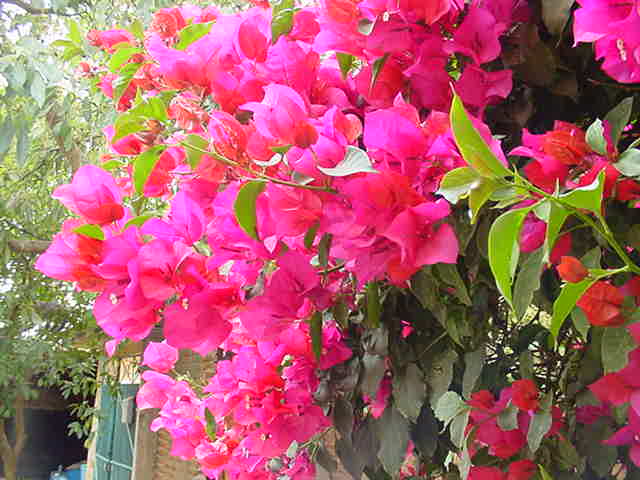
Bouganvilleas in Chacala

Bouganvillea with automatic nitrogen units

Bouganvilleas seem to grow wild in Chacala. Well, almost wild. I have had some very nice experiences with Bouganvilleas here. Much different in the Zone 5 world, where they cost $30 dollars and last for three or four months. Here they are about $2 or $2.50 USD and last forever and grow like crazy.

This summer is my third summer housesitting in the same Chacala house, and I feel very attached to some of the plants here. Mostly because I selected, planted, and continue to care for many of them.

The Spring before last I went to the La Penita plant nurseries with my summer landlord and landlady to pick out plants for around the outside of the house. Among other plants, we got four pots, one foot tall each, of bright purple bouganvilleas for the south side of the house, which is two stories high on that side.

After we picked out the locations, one of the local guys dug holes in the ground with a pickaxe. It took about an hour a hole. We put dirt from the nursery in the holes and watered the holes for a couple of days. It was at least three months til the rainy season, and we were worried about the watering situation.

Anyway, we planted them and watered almost daily for a month or so, and they took off. 12 to 15 feet tall that summer, more in the winter. They have no been living here about 15 months, and they are growing like crazy. Stems are 1 1/2 thick or more, crawling up the house unto the roof. I have been cautiously pruning them back, even though my garden advisor, Berta, who gardens next door, said I should whack them way back.

There have been a few set-backs. One bright morning the owner of the empty lot next door brought some spray guys in to spray his lot with some horrible herbicide. I heard them outside in the jungle and called to them, hysterically, and got them to stop while I begged the owner to keep the spray away from the house.

Unfortunately this house is built right to the lot line, so he wasn't very cooperative at first. But he finally agree not to spray within about fifteen feet of the house. Saving a bunch of palms and shrubs and fruit trees and all the bouganvilleas. Except for the one that got a "healthy"dose of the spray before I stopped the spray-guy. It still took the poor baby about six months to die.

And now, I fear, tragedy may strike again. Last night there was a nice big wind, thunder, and lightning storm with about 10 seconds of rain. When I went downstairs this morning to check the water supply I found that one of the bouganvilleas had been torn lose from the pillar it has been climbing up, and was lying on the ground. Or most of the branches/vines were on the ground. Still attached, and not broken, but no longer growing up the side of the house.
So, for the moment 20 feet of bouganvillea are lying across a bunch of baby palms and miscellaneous other plants I don't know the name.

Anyway, I got out my trusty Corona pruners (26 years old) out, and found the branches were too thick and sturdy to cut through. I am afraid the thick branches are going to starting breaking and cracking before I can get some stronger clippers. Or maybe a pruning saw.

So I am off to borrow or buy some big clippers. I don't think they sell them in Chacala or Las Varas, but someone might have some around town. I have to look up the name and then draw a picture of what I am looking for. My dictionary doesn't seem to have the correct names for tools, which can lead to some awkward moments, but that's another story.

On a more cheerful note, this past winter my landlady/landlord bought some more bouganvilleas with really beautiful colors, which are now planted in with the purple ones. It's going to look so beautiful. They are only about two feet tall right now, but they are starting to take off. I can't wait.

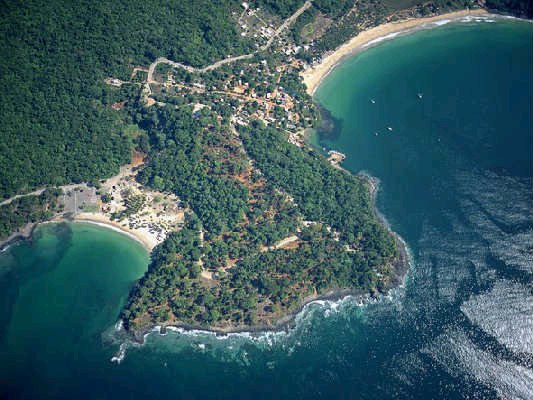
Overview shot (pelican view) of Chacala

Monday, June 26, 2006

Digging the Dirt in Chacala

One of the harder things about gardening in Chacala has been finding good soil. And figuring what good soil looks like here, and where to get dirt, and finding out who knows about good dirt, and finding dirt for my pots.

All my Zone 5/6 clues about what good gardening soil looks like are out the window here in Chacala. At my first place in Chacala the soil looked like hard packed red clay to me. And Aurora, my landlady was growing very nice bouganvilleas and hibiscus and other plants right in it. She was trying to grow roses in the dirt, but ended up using pots with river dirt.

Aurora and I did some landscaping in front of her rental units, a small flower bed. We built the walls around it with miscellaneous rocks and bricks and cement blocks, and then headed for a local river bed for sandy-looking soil. The plants grew okay in the dirt, but not vigorously, and I wasn't sure what to do. The soil compacted easily, and water tended to run-off rather that soak in.

In my previous gardening life I would have just added organic matter. At the farm I would have had compost and hay/straw, chicken bedding, cow bedding, all kinds of stuff. In town, I would have gone to the local garden supply and gotten a truckload of nice compost, or topsoil, or whatever I wanted. It's different here, and I think the main problems are not knowing enough garden Spanish, and not understanding the thinking about soil here.

I spend alot of time around in Chacala looking at other people's gardens and flower pots. I have never been able to easily stick my finger into the soil the plants are in. It is always hard, like clay. I am assuming it's lack of organic material. Most people in town rake around their houses daily (mostly raking leaves from fruit and other trees), leaving the ground hard and bare. They burn the leaves they rake up.

Local varmint, looking for dinner

Apparently the raking is to reduce the spiders, insects, and small animals around their houses. A safety practice. Making piles of organic material will draw varmints (which are already around town at night) and the dogs alway like to tear piles apart to make nice soft beds.

The main residential street in Chacala.
Every house has some effort at growing flowers,
and there are fruit nears neat most houses.


Most people grow their plants in pots, using sandy soil they have gotten from some river bed.
I have done that, and have also been buying gunny sacks full of "topsoil" at the two plant nurseries in the second town over from here (near La Penita). It's potluck what kind of dirt will be in those sacks. The first few times I bought sacks of dirt it WAS nice rich topsoil, and the plants did well in pots filled with it. But sometimes its almost straight sand and other times it looks good until you get it wet and then it turns to what appears to be straight clay.

I always ask people with nice plants where they got their dirt, and the answers are not clear. I think only a few people (my old landladies mainly) are willing to share their dirt sources. On the other hand, maybe they don't understand what I am asking or I don't understand their answers. My Spanish is improving, but it's still difficult when the person speaks quickly.

A couple of weeks ago I thought my prayers for good soil were answered. The landscapers for the big gated community near where I am living trucked in about 30 large dump truck loads of what looked like good topsoil right in front of the mango orchard next to the house. They said they were making a dirt storage pile for plantings around the newer houses in the development.

I say "looked like" because, after carrying, with permission, 12 bucket fulls of dirt up to the house, I realized it was very claylike, and I guess had no organic matter. I put some in planting pots and watered it. The next day it looked like I had made round bricks. I turned the pots over and tapped the dirt out. Came out in nice hard bricks. Like adobe. Not too great for plants.

I still take may chances buying topsoil from the nursery, but the main problem is getting the sacks home. I usually take a series of collectivos (taxi vans) back and forth from Chacala, to Las Varas (the local "real" town), and then down the highway to La Penita. Both nurseries are outside of town, so I get off the collectivo, do my business with whichever nursery I am going to, and then walk back across the highway with as many plants and pots as I can carry. But the sacks of soil are too heavy for me, and the drivers don't want to fill up the van with non-paying sacks of dirt. Then I reverse my trip back to Chacala, hoping the driver will bring me right to my driveway.

Since I can't get dirt the collectivo way, I am always looking for someone to help me get some sacks of soil, or pick some up for me. It's not easy to find someone wanting to do it. And sometimes it's a little awkward. Either the driver insists I not pay for their help or they want much more than I can afford. Or the person is doing me a big favor that would be hard to repay.

But the quality of the soil is still the main problem. Oh, for the days of sacks and piles of lovely black dirt, smelling good, and full of humus in my old hometow. There for the buying. I know I will figure out the dirt situation here, but it hasn't been easy.

At first glance it's hard to see that a gardener lives here.
But there are some beautiful plants, including an incredible bouganvillea
that covers that big tree.

Gardening under the Coco-palms in Chacala

Looking up from my hammock on the beach in Chacala

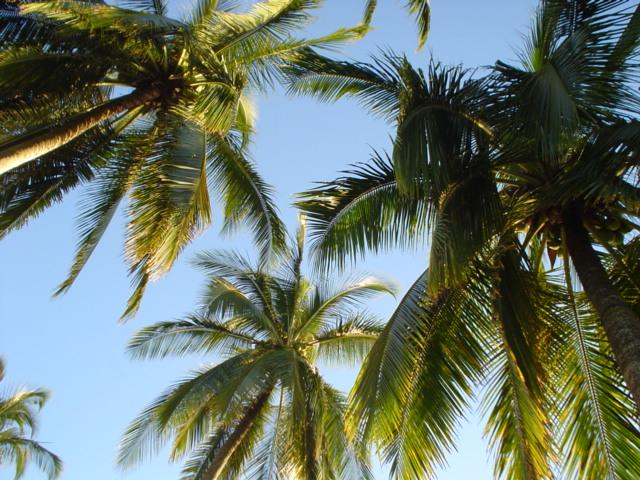
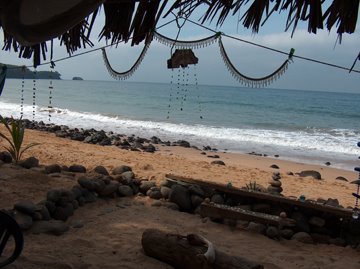
This past winter I camped for six months on the beach in Chacala, right on the beach within a few feet of the high tide line. I was surrounded by coco-palms. I don't know anything about the names of different palms yet, but that's what people here call them.
Looking out from my table, at my beach camp.

I lived under a ramada made of palm fronds, hung my hammock between two palms, and loved the shade of the palms. And used dried fronds for fire starter, and trimmed fronds for lumber. I also had to watch for falling fronds. They are self-pruning, and when a 30 foot long palm frond falls off a tree, you better be out of the way. Also, the coconuts are always falling. One day one came right down thru my ramada (palm front flat-roofed shelter), and thru the rain fly on my tent, then the roof of my tent, and landed on my pillow. Luckily my head was conventiently located elsewhere at that moment.

Another time my two-year-old neighbor was standing in my camp, fooling with crayons. A large coconut fell thru the ramada and missed his head by two inches. Luckily his Dad was right there, and saw the coconut and Markito's tiny sandal prints inches away. Within minutes he was up the palm, barefoot, and hacking clumps of old coconuts off the tree.

The biggest learning experience for me about gardening on the beach is the impact of the salt water and the intensity of the sun reflecting off the water. I brought about 10 pots of plants from the other house. Some quickly didn't do well, and I gave them away.

After a few experiments I stuck to succulent-type plants, which seemed to best tolerant being 10 feet from the ocean half the day. I kept all the plant pots under the front edge of the palapa, facing west, so the plants only go a little direct sun each day. I even hung mosquito netting on that side of the ramada, mostly to protect me from the heat of the late afternoon sun, setting over the ocean. Also for the poor plants, which really took a beating.
Palm trees on the beach at Chacala

One day while I was living on the beach my landlady came over, and said "Venga", "come". So I grabbed by umbrella and she grabbed a little trowel and a wheelbarrow and off we went. To the shady damp area near her place. It used to be a stream bed, and usually is for awhile during the rainy season. Other times we have come here for wheelbarrows of dirt.

But today Esparanza had a new project in mind, transplanting coconut palm seedlings. I had noticed that occasionally on the beach there would be coconuts with foot-tall plants growing out of their shell. But when we got to the streambed I realized the ground was covered with sprouted coconuts, sitting on the damp earth. We picked up about 20, and then dug up some other plants. One looked like "Elephant Ear", but who knows. Whenever I ask for plants around here people are amazed I don't know, and then usually give me some name like "boy's bottom" or "dangling toe" or something. At least that's what it sounds like to me.

Anyway, we wheelbarrowed our treasures back to camp. Esparanza's house is on the beach road, and my camp was under a ramada between her house and the beach. When I first moved to the beach one of the family members told me that the family had planted all the 7o or 80 palms around their house about 20 years ago. I was amazed they were so big. Maybe 30 feet or more. Anyway, it turned out our project for the day to to re-plant palms where the Easter crowd (thousands of people camp on Playa Chacala for the two weeks of Easter/Semana Santa) killed about 10 of the smaller (two feet or so) palms she had planted last year during the rainy season. So we planted the sprouted coco's in the sand. No dirt. And my job was to water them everyday, with sweet (not ocean) water. Which I did. I haven't been back to check on them for a couple of weeks, and I hope they are doing okay.

Gardening in Chacala: Desert Rose

This is my favorite plant in my garden of pots on my terrace in Chacala, Mexico.
Desert Rose, Rosa de la Desierto, Adenium Obesum
I have been learning to garden in Mexico for almost three years now. I moved to a small town on the Pacific coast with the intention of learning how to garden in brand-new climate.

Before I moved here I gardened in Zone 5-6 for more than 40 years, so this is a very big change.
Some of the plants I grew in my old garden, I also grow here.

The difference is I grow them year round here: gardenias, bouganvilleas, hibicus, all kinds of succulents, lime trees, chili peppers, all fruit trees, oleander, and my very very favorite, Desert Rose. This plant flowers year round, is always in bloom, and is easy to propagate, and I love it's shape.
Here in Chacala the weather in the winter is usually low's in the low 60;/highs in the mid-80's. In the summer it is pretty humid, with lows in the low 70's and high's in the mid-90's. It rains starting in late June, with the most rain coming in August and September. But from mid-October thru mid-June it very very rarely rains here.

Sunday, June 25, 2006

New Gardener in Chacala


Semi-abandoned banana orchard up the hill from Playa Chacala
I love my life here in Mexico. However, it's been hard having to learn a whole new climate. It almost feels like I am starting all over again as a gardener. I lived, gardened and farmed, in Zone 5 for many years, and Chacala couldn't be more different.

It's a mixed blessing. I can garden outside every day of the year here. I wake up every morning with sunshine coming unto my bed. I wear shorts and flipflops and eat breakfast outside. And sometimes breakfast includes a mango, straight from the tree.

It is so different here. But actually it's a lot like Los Angeles, where I grew up. A lot of the same plants. Poinsetta (Buenanoche), oleander, jasmine, bouganvilla, hibiscus, lantana, desert rose, and a bunch of others where I only know the Mexican name.

There's also a lot of vinca, (at least it looks like vinca), which flowers year round and never seems to fade away. Then there are different kinds of palm trees, and beautiful large trees similar to Madrone (maybe they are Madrone) and lots of flowering trees. And flowering vines. And all kinds of fruit trees, although they are mostly cultivated at someone's house or in an orchard. There are mangos and papayas, guayabas, and lemons and other fruits I don't know the name of. And melons (cantalupe) , pinas (pineapple), and sandia (watermelon) year round.

This area could be a great place to have a modified Survivor show, for lazy people. Fruit trees all over, and pinas, and fish, and shrimp and lobsters. In the evening the local guys just snorkel down off the beach to pick up the lobsters. Of course, there may be lobster seasons, natural and legal. I don't know. But restaurants seem to serve lobsters and shrimp year round.

Anyway, here in Chacala, I don't have much of a clue about the plants . Even if I recognize a jasmine, a hibiscus, or a bouganvilla, or whatever, I don't know the name in Spanish. And the nurseries generally don't label plants so there's a lot of guess work involved in choosing plants. Last spring we bought four bouganvillas that were all supposed to be magenta vine-types and we ended with 2 red and 2 magenta, and 3 vine and one bush. Oh well. For about $2.30 USD for a good sized plant, that's not too bad.

There is a lot of plant sharing here. And I have learned more about starting plants from cuttings. It seems to be easier here because it's so humid and the cuttings don't dry out all fast. In fact, often when someone builds a fence with wooden fence posts, the posts sprout and turn into trees. The fences looks nice because after a couple of years there is a line of trees along the fence line.

I think very few local people have ever bought a plant from a nursery, or even visited one. About two months ago one of the vendors that sometimes sells plants at the local Friday market came down to Chacala to deliver some plants to me. I couldn't carry everything and the plant guy was curious about my house. I don't think he had never been in Chacala before. It's about five miles from the town where he sells plants. Anyway, everybody who saw the truck at my house came over to check out what was going on, and now the guy comes down most Saturdays. It's a little more expensive that at the market, but it's handy. And it's fun to see the new plants at people's houses.

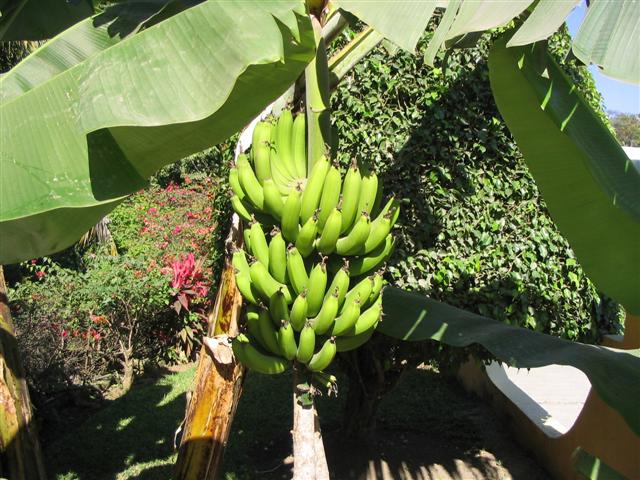
Neighbor's house, banana stash
I am still not up-to-speed about the climate here. This is my third summer here, and I am finally getting used to the humidity and the bugs. Nobody much tries to grow tomatoes or melons at home, except for chilies, because of the bugs. Plus they are really, really cheap to buy. In the summer it's in the mid 80's to mid 90's and higher and very, very humid, from about 7am to midnight, with low's in the high seventies for a couple hours in the early am. In the winter it is more low/mid eighties in the day and mid sixties/low seventies at night. Very nice.

But it is fun learning all this stuff. This year it didn't rain at all between early October and late June And we still, June 23, have not had more than one or two very light sprinkles. It's wonderful in Chacala when the rainy season really takes off. There are tremendous rain/thunder/lightning storms, mostly at night, during the four or five months of the rainy season (June/July thru October). The sunsets are gorgeous every night because the clouds are building up to storm.

One of the problems with gardening here is there the lack of rain for so many months. And many vegetable plants seem to kind of shut down when it hits about 84 degrees. Things get very dry and a lot of the trees and shrubs and vines seem to be deciduous. I didn't realize that until the first June I was here and all these (what I thought were) dead trees and shrubs burst into bloom.

The house I live in (I housesit here here for six months for the past three summers) is the highest house in the town water system, meaning there almost always is not enough pressure for town water to reach this house. Last year I had town water twice, a trickle for about a half an hour each time. Until mid-June of this year, whatever what came thru the town water lines came froma small creek. And, especially during the rain season, the water was full of dirt. Brown and muddy. But now Chacala has a well about four miles away, with a pipe to Chacala, and most houses get water almost every day for a couple of hours. This is really different frm the past few years, when an hour or two twice a week was the general rule.

Everyone in house (almost) has at least a plastic water storage container, a tinacho, which is filled by the town system. Many people also have a hebe, an underground water storage vault made from bricks/cement blocks and cement plaster. The town water flows into thehebe and then is pumped to the tinacho on the roof so there is some water pressure in the house. Most people have toilets now, mostly flushed with a bucket of water. There are a number of houses without real roofs, and sometimes the owners just build a cement block stand about 10 ten high for the tinacho to sit on. Water is pretty precious here and is never taken for granted. Everyone is alert to the sound of running water, and keep they eyes open for the water running from the town lines.

Water from the town system is never drinkable any time of year, so everyone seems to buy drinking water in five gallon blue plastic jugs for about one dollar (10 pesos). Several different water trucks come around everyday, so that's no problem if you have some money.

During the rainy season I catch water that runs off the roof to water the plants.

Until this last month, I bought household water (toilet, shower, clothes washing, plant watering, etc) from the water truck. It's a large tanker truck that delivers water mostly to restaurants (which need more water than the system delivers), and to the four swimming pools in town (three at small hotels and one at an American's house). A tanker truck full cost about 40 dollars but I could only take a half tank at a time so I coordinated with a neighbor that also buys water and we split a load. I used a 2500 liter tank (tinacho) of water a month, more of less.

I have hibiscus and jasmine and lots of other stuff at the house where I am housesitting. Oleander. Bouganvilla. But I have so much to learn. The local ladies help me alot. I think that they can't comprehend how totally different gardening is here. The idea of two or three feet of snow gets them laughing. I think they think I am kidding. anyway.... I like this life alot. Very simple and uncomplicated. It least its simple and uncomplicated for me, since I am not earning a living and I don't understand enough Spanish to get into trouble. At least not so far.

One terrace at this house is at the front of the house, and is almost all shady. I have jasmine, camellia, and some palms and some shade leafy plants, and a flowering vinca and several pots of coleus. I grow the coleus from seed, and they are very popular with people around town. People come up to take cuttings (pinches) all the time.

I think the front terrace looks great. Very lush and things smell good. Plus the bouganvillas are growing up past the terrace wall, come up from the ground in front of the terrace. There are some chairs and a table out there and it's handy for visiting with people that I don't want to invite in or who don't want to come inside. Nobody seems to have much wooden furniture here, I think because the termites and other bugs eat the wood. I use oilcloth on the table because I like the bright colors.

The other patio is called the veranda, and it's pretty big, maybe 20 by 30 feet and is half covered. It looks to the west, out over the ocean and I spend a lot of time in the hammock out there. I have a bunch of sun lover's out there, including hibiscus and desert rose and a shrubs with little blue flowers that bloom constantly, year round. And a bunch of other stuff. I am mostly experimenting with what will grow and how to start plants from cuttings and seeds. I have done a lot of experimenting with morning glories, sunflowers and nasturiums, with mixed results.

An except for the bouganvillas, all the plants are in pots. So I am always needing dirt/potting soil. Next week I am going to get some at the nursery in La Penita, a town about a half an hour away. I will catch the collectivo here in Chacala, and then from Las Varas take the Pacifico bus to La Penita. Since I can't carry five bags of dirt ($2USD per gunny sack full) I made arrangements with my favorite taxi driver to met me with his van in La Penita, after I have been there a couple of hours, and drive me back to Chacala. I am bringing a tarp so the van don't get too dirty. I am going to buy some plants too. I can't wait. He is charging about $14USD which is pretty good, considering it will be about an hour of his time. He named the price. And I will probably tip him. His wife is about to have their first baby and I have been trying to think of a nice present, but maybe a good tip is the best present. I don't know.